The Silent Quote: Why Tradespeople Lose Jobs
A reform contractor sends three quotes on Monday morning between site visits. By Friday afternoon, two have gone silent. The temptation is to read that silence as a polite no, file the leads under “not interested”, and move on to the next week of estimates.
That reading is almost always wrong. A quote sitting unanswered in a homeowner’s inbox is rarely a rejection. It is a thread that has scrolled past three days of newer messages while the prospect spent the week handling everything other than your bathroom remodel. The person who wins that job is not the cheapest bidder; it is whoever is still visible when the homeowner sits down to decide.
Why quotes go silent
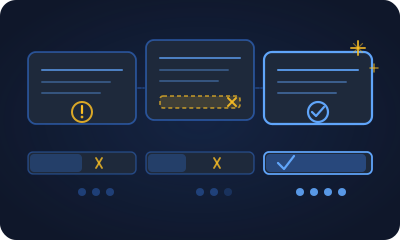
Three things happen to a quote between the moment you hit send and the moment a prospect actually decides. They are deciding slowly, weighing your number against one or two others and waiting on a partner to agree. They opened your email on a Tuesday morning, meant to reply that evening, and by Tuesday evening four newer threads had pushed yours below the fold. Or their inbox is the kind of inbox where everything below today is functionally invisible, and the quote you spent forty minutes preparing is now keeping company with a parking receipt and a school newsletter.
None of those three states is a no. All three are operational invisibility, and they share one feature: the prospect is not going to surface your quote on their own. Either you bring it back into view, or it stays buried until they hire someone else and feel briefly guilty about not replying.
For a solo electrician or plumber or reform contractor, this is the part of the job that gets squeezed out. The estimate visit happens at 8am, the writeup happens at 9pm, and by the time Friday arrives the memory of Monday’s send is buried under Tuesday’s emergency call-out and Wednesday’s parts run. The quote is not being neglected because the tradesperson does not care. It is being neglected because nothing in the workday tells them to remember it.
The three outcomes of a sent quote
Every quote that leaves your outbox lands in one of three end states. The split between them is not about pricing or workmanship. It is almost entirely about who chased and when.
A few days after the send, a short nudge lands while the prospect is still actively deciding. The reply comes back the same day, often with the answer pre-formed: “Yes, when can you start?” The follow-up did not close the job; it just let the prospect close it.
The homeowner had three quotes open. Two went silent. The third tradesperson sent a polite “any questions?” on day five and got the conversation moving. By the time you remember to check in, the deposit has already been paid to someone else. The pricing was identical. The visibility was not.
The thread sits in the prospect’s inbox and yours. Neither party closes it. Six months later you find it while searching for a different address and realise the job was probably winnable on day six. This is the largest category in most solo operators’ inboxes, and the one nobody measures.
The uncomfortable thing about that third category is that it represents revenue that was already paid for in time. The site visit, the measurements, the writeup, all done. The only step left was a two-line email on the right day, and that step is the one that loses to a Tuesday emergency every time.
Why phone follow-up fails for solo operators
The standard advice for tradespeople chasing quotes is to pick up the phone. It is not bad advice in isolation. A direct call to a homeowner who is genuinely deciding can shorten the loop by a week. The problem is the operational geometry.
A one-person plumbing business is on a job site from 8am to 5pm. That is also when the homeowner is at work. The window where both parties are free to talk is roughly 6pm to 8pm, which is also when the plumber is writing tomorrow’s quotes, eating dinner, and trying not to think about pipes. A scheduled call requires both parties to defend a time block, and the solo operator is the one with no admin staff to defend it for them.
Even when the call connects, it carries a tone the email does not. A phone follow-up reads as harder pressure than a written one. For a 800€ replacement boiler quote the prospect was already going to accept, that pressure is unnecessary. For a 12,000€ bathroom reform they are still weighing, it can feel like sales pressure on a decision that was not yet asking to be made.
A written follow-up solves the timing problem because it does not demand the prospect’s attention in real time. It solves the tone problem because the prospect reads it when they are ready to think about the decision, not when they are walking back to their car. And, crucially, it surfaces at the moment the tradesperson opens Gmail, not at the moment some external task manager decides.
- The solo operator’s schedule and the prospect’s schedule rarely overlap during business hours.
- A written nudge lets the prospect respond on their own clock, which raises the reply rate.
- A reminder that lives inside Gmail surfaces at the only desk-time moment the tradesperson has: when they sit down to send the next quote.
Setting a time-anchored reminder at compose
The single habit that closes the gap is attaching the follow-up reminder to the quote at the moment you send it, not deciding later to come back. Later does not happen. Compose time is the only moment when the quote is fully in your head and the next steps are obvious. This is where Mail2Follow earns its place: it adds the reminder controls directly into the Gmail compose window, so the choice to chase in three days or seven is part of sending the email, not a separate task to remember.
The flow looks like this. Open Gmail on the phone or laptop. Compose the quote reply with the budget attached. Above the body field, toggle Mail2Follow tracking on for this send and pick the reminder window: three days for smaller jobs the prospect can decide quickly, seven days for larger reforms where they need to talk to a partner. Send. The reminder is now anchored to that exact thread.
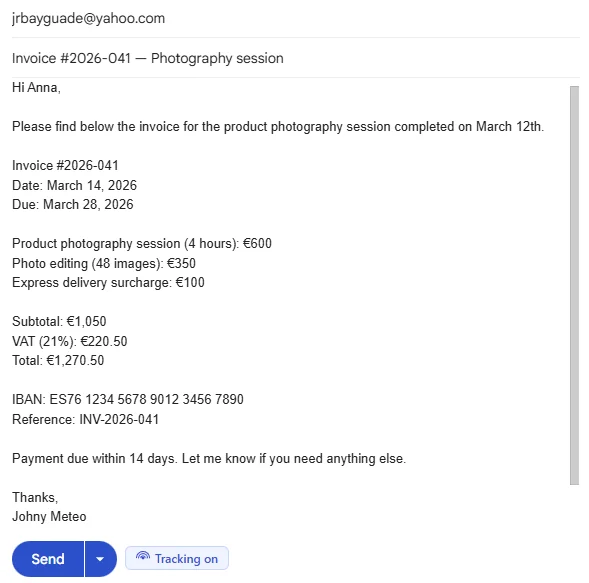
A representative quote for a bathroom reform might look like this when it goes out:
Hi Laura,
Thanks for showing me the bathroom on Monday. Attached is the quote for the full reform: stripping the existing tiles, replacing the plumbing rough-in, new shower tray and screen, vanity, and retiling floor and walls. The total is 11,840€ including materials and labour, with the timeline at roughly nine working days once we start.
The quote is valid for 30 days. If you want to walk through any line item, I can call this Thursday evening or next Tuesday morning before site.
Let me know if you would like to move forward and I will block dates in the calendar.
When you hit send, the seven-day reminder is now part of the thread. There is nothing to remember, no spreadsheet to maintain, no calendar entry to write. The quote is sent and the chase is already scheduled.
When the reminder fires: AI-drafted follow-up
Seven days later, the reminder surfaces. Not as a phone alert in the middle of a job, but as a notification waiting in Gmail when the tradesperson next opens their inbox. The original thread is at the top with a small banner: this quote has not had a reply, here is a suggested follow-up.
The follow-up is not a blank cursor. Mail2Follow drafts it by reading the original thread, the tone you used, the language (Catalan, Spanish, English, whichever the quote was in), and the specific job you quoted. The draft that appears is short, professional, and already references the bathroom reform on Provença. Three lines, no template feel.
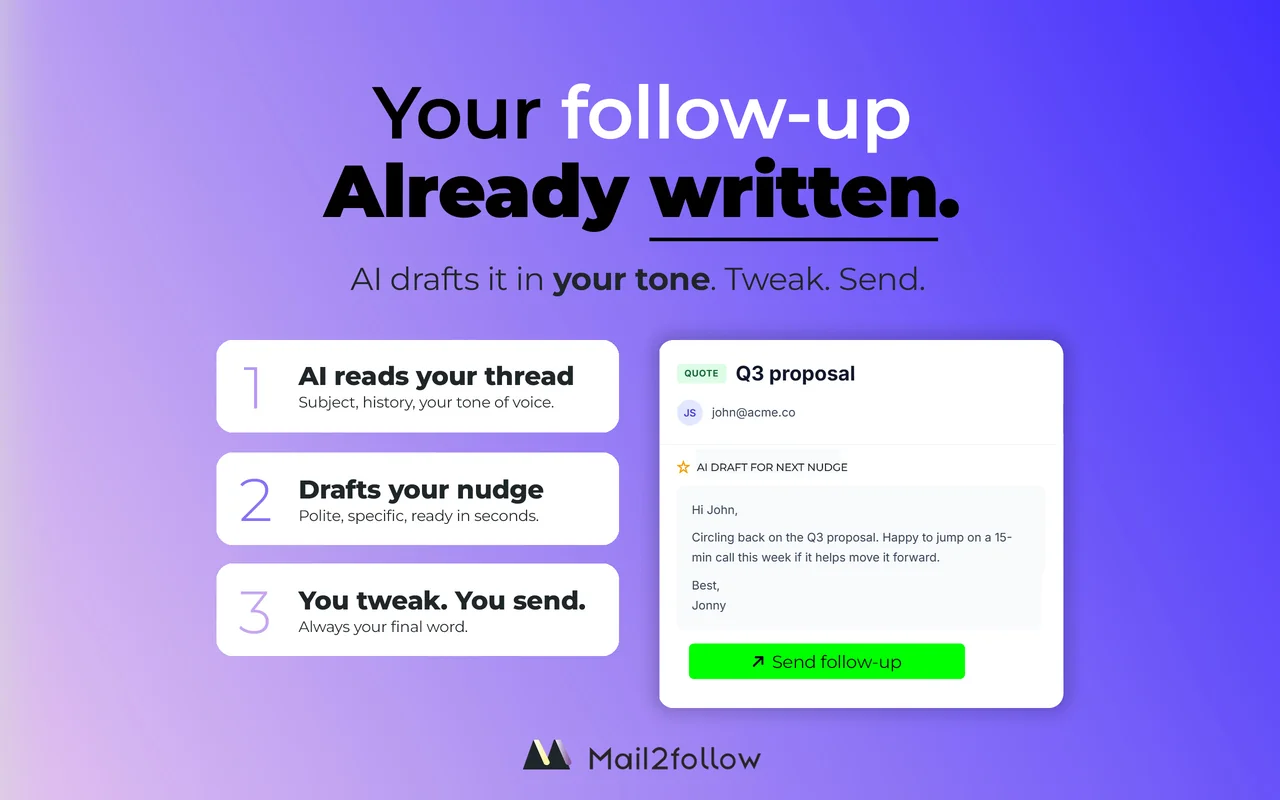
The reader reviews it. Maybe they soften one line, add a sentence about being available for a site walk on Saturday, and hit send. The whole interaction takes under a minute and happens in the same Gmail tab where the original quote was sent. No context-switch, no separate dashboard, no rewriting from scratch at the end of a 12-hour day.
When the homeowner does reply (and they reply far more often to a follow-up than they ever would have to silence), Mail2Follow detects the response and resolves the reminder automatically. The thread closes itself.
Staying visible without pestering
The instinct that holds tradespeople back from following up is the worry that it will read as pushy, or worse, desperate. That worry is sound when it is aimed at the wrong follow-up pattern. A multi-touch sequence with seven scheduled emails over three weeks does read as desperate, and is also wildly out of scope for a one-person operation. What works is the opposite: a single, well-timed nudge that arrives when the prospect is most likely to be actively deciding.
A reform contractor sending one polite check-in five days after the original quote is doing the prospect a favour. The homeowner who genuinely forgot now has the thread back at the top of their inbox. The homeowner who is still weighing options now has a small prompt that says you are organised and responsive, which is itself a signal about how you would run the job.
The mistakes to avoid are the ones that turn the nudge into pressure:
A 24-hour bump reads as anxious. The prospect has not had time to read the quote properly. Wait at least three working days for small jobs, seven for anything over five thousand euros.
One nudge is professional. Three is harassment, and the prospect will remember the harassment longer than they will remember the quote. If the first follow-up gets no reply, accept the silence and move on after one more attempt two weeks later.
The prospect knows they got it. The question reads as accusatory. A better line: “Wanted to check whether you had any questions on the bathroom quote before the validity runs out.”
Cutting 10% in the chase email tells the prospect the original number was inflated. If the price needs to move, move it in a conversation, not in a one-line nudge.
The goal of the follow-up is not to close the job in that email. It is to put the quote back in front of the prospect at the moment they are deciding, so that when they do choose, you are one of the names actually on the table.
From forgotten quote to signed contract
Over a month, the difference between attaching a reminder at compose time and trusting yourself to remember is not subtle. A solo electrician quoting twelve jobs a month who follows up on all of them will close noticeably more work than the same electrician quoting twelve jobs and chasing the three they happen to remember on Friday afternoon. The workmanship is identical. The pricing is identical. The only variable is whether the quote stayed visible long enough to be decided on.
The compounding part is what tradespeople tend to underestimate. A won job is not just the value of that contract; it is the referrals from a happy homeowner, the photos for the portfolio, the next-door neighbour who saw the van and asks about their kitchen six months later. Each forgotten quote forfeits not one job but a small chain of downstream jobs that would have followed from it.
None of this requires a CRM. There is no pipeline to maintain, no contact records to enrich, no weekly review meeting with yourself. The entire system is two clicks at the moment the quote goes out, and a one-minute review when the nudge surfaces in Gmail a week later. The work the tradesperson is already doing (writing the quote, sending the quote) gets one small addition that quietly pulls the third-category quotes out of the never-chased pile and into the won-or-lost pile where they actually belong.
A quote sent with a reminder attached is a quote you will actually follow up on. That is the whole product, and for a one-person operation it is the difference between a calendar full of jobs and a calendar full of quotes that never got an answer.
Free forever · 15 tracked emails / month · No credit card