Follow Up on an Unpaid Invoice Without Losing the Client
The hardest invoice to chase is not the one from the stranger who ghosted after a single project. It is the one from the client you have worked with for years, who has always paid, and who has now gone quiet two weeks past the due date.
Push too hard and the relationship cools. Say nothing and the client quietly learns that late is fine. Most advice on this topic stops at “send a polite reminder” and leaves the actual writing to you, which is the part that matters. A reminder that reads like a billing system speaks for you whether you wanted it to or not.
- Why trusted clients pay late (and why it is rarely about you)
- What the first follow-up should sound like
- Three mistakes that quietly damage the relationship
- When and how to escalate without burning the bridge
- How open tracking removes the guesswork
- Using AI drafts that match your tone, not a template
- Three real scenarios across freelance roles
- The follow-up that preserves the relationship
The Silent Invoice: Why Good Clients Pay Late
Trusted clients almost never go silent because they decided not to pay. They go silent because something mundane happened on their end, and your invoice landed in the wrong week.
Three explanations cover most cases. The first is cash flow timing: a boutique agency waiting on its own large client before paying yours, or a small studio that runs payroll on the 10th and processes vendor invoices the following week. The second is inbox noise: your invoice arrived during a launch week or a holiday and slid below the fold. The third is approval friction: the founder who hires you needs to forward the PDF to an external accountant or a partner, and that handoff stalled.
None of those reasons are personal, and none of them require an apology from the client. They do, however, require a nudge from you. Without one, the invoice stays exactly where it is: forgotten, not refused.
This reframing matters because it shapes the tone of the first message. You are not accusing anyone of anything. You are surfacing something that fell off a desk. A freelance illustrator who internalises this writes a different first line than one who has spent the last 48 hours convincing themselves the client is avoiding them.
- A silent invoice is usually cash flow timing, inbox noise, or stalled internal approval.
- The first follow-up is a nudge to a busy person, not a recovery action against a defaulter.
- Tone follows the assumption you start from. Start from charity.
The First Follow-Up: What to Say and What Not to Say
Two follow-ups can be equally polite, equally short, and equally professional, and one of them still feels wrong. The difference is voice.
Consider a freelance translator who has been working with the same publisher for three years. Most of their thread history is warm and casual: first names, short paragraphs, occasional shared jokes about deadlines. Then the invoice goes seven days past due, and the translator opens a fresh blank email and writes this:
Dear Anna,
Please be advised that invoice 2026-014, dated 18 April, remains outstanding as of today. Kindly arrange for payment at your earliest convenience.
Should you require a duplicate copy of the invoice, please do not hesitate to contact me.
Nothing in that message is rude. Every line is, technically, fine. But it does not sound like Marta, and Anna will notice. The shift from first names to “Dear Anna”, the formal phrasing, the legalistic “be advised”, all of it signals that the relationship has changed register. The invoice has become a matter, not a question.
The version that matches the existing thread looks like this instead:
Hi Anna,
Quick nudge on invoice 2026-014 from the April batch, it’s about a week past due and I wanted to check it didn’t get lost on your end. No rush if it’s already in the queue, just flagging it so it doesn’t slip further.
Happy to resend the PDF if useful.
Same ask. Same information. Different relationship preserved. The second message reads as a continuation of the conversation Marta and Anna have been having for three years, not a sudden switch into accounts-receivable mode.
The Most Common Mistakes That Damage the Relationship
Three errors recur across freelance roles, and each one quietly trains the client to treat your invoices as optional.
A graphic designer who lets a 1,400€ invoice sit untouched for 21 days past due is not being polite, they are teaching the client that the real deadline is whenever the designer finally complains. The first nudge belongs at day 7 to day 10, not day 21. A short message at the right moment costs nothing; a long silence followed by a frustrated email costs the next contract.
"Sorry to bother you about this…” opens a follow-up from a freelance copywriter and immediately puts them on the back foot. The invoice is owed. Asking about it is not a bother and not an imposition. Apologetic openings signal that the writer thinks the request is unreasonable, which gives the recipient permission to treat it that way.
An independent architect who has spent six months on first-name terms with a developer client should not suddenly send “Dear Mr Vidal, please find attached…” over a late invoice. The register shift reads as cold, and cold reads as adversarial. Match the voice of the existing thread; the invoice number does the work that formality is trying to do.
When to Escalate the Tone, and How to Do It Without Burning the Bridge
A second follow-up is not a louder version of the first. It is a small, deliberate shift, and the shift only happens once the first nudge has had time to land.
A workable cadence for a long-term client looks like this. Day 1 is the invoice itself, sent the moment the work is delivered. Day 7 to day 10 is the first gentle nudge, written in the voice of the original thread, assuming nothing went wrong. Day 14 is the second message, slightly tightened: still warm, but with a clearer ask and a concrete date. Day 21 is the formal escalation, where you name the situation directly and propose a path forward.
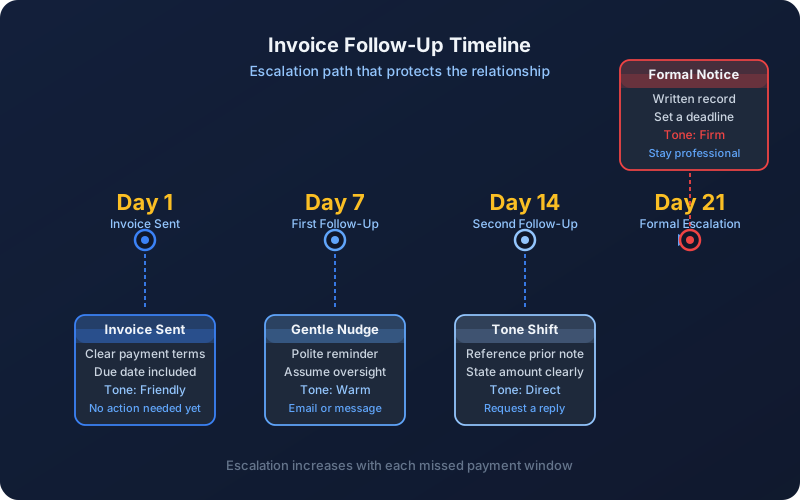
The day 14 shift is the one most freelancers get wrong. It should not become apologetic (“really sorry to chase again”) and it should not become accusatory (“this is now significantly overdue”). What changes is specificity. Instead of “no rush”, you ask whether there is anything blocking the payment on their end and whether it would help to talk to their accountant directly. You move from a nudge to a conversation about logistics.
By day 21, if the client has still not responded, the message can be direct without being hostile. Name the invoice, name the elapsed time, propose a concrete next step (“would it help if I sent this directly to your bookkeeper?”), and make clear that you assume there is a reason rather than malice. A consultant chasing a 4,000€ retainer fee from a long-term client at this stage should sound concerned, not litigious. Concerned earns a phone call back; litigious earns silence.
The hardest part is trusting the cadence. A freelance photographer who skips the day 14 step and jumps straight from a soft nudge to a formal demand has compressed two weeks of relationship management into one jarring email. The client reads the jump, not the words.
How Open Tracking Changes Your Follow-Up Strategy
The biggest variable in follow-up tone is not the elapsed time. It is whether the client has actually seen the invoice.
Without that information, every freelancer fills the gap with assumptions, and the assumptions are usually wrong. A reform contractor who assumes the client is ignoring a 6,000€ quote when in fact the email never reached the inbox writes a tense follow-up to someone who genuinely has no idea anything is owed. A boutique agency that assumes the invoice is sitting in a queue when in fact the client opened it three times and chose not to pay writes a soft nudge to someone who needs a firmer conversation.
Open tracking collapses the guesswork. If the client opened the invoice on the day it arrived and again two days later, the situation is not “lost in noise”. It is “seen and parked”. The follow-up can address the actual blocker: cash flow timing, an approval step, a question about the line items. If the invoice was never opened, the first follow-up writes itself: a short message, no edge, possibly a resend.
Mail2Follow surfaces this directly inside Gmail. Tracked invoices and quotes appear in a small dashboard with status chips per thread, so the photographer chasing two outstanding invoices can see at a glance which one is genuinely buried and which one is being avoided.
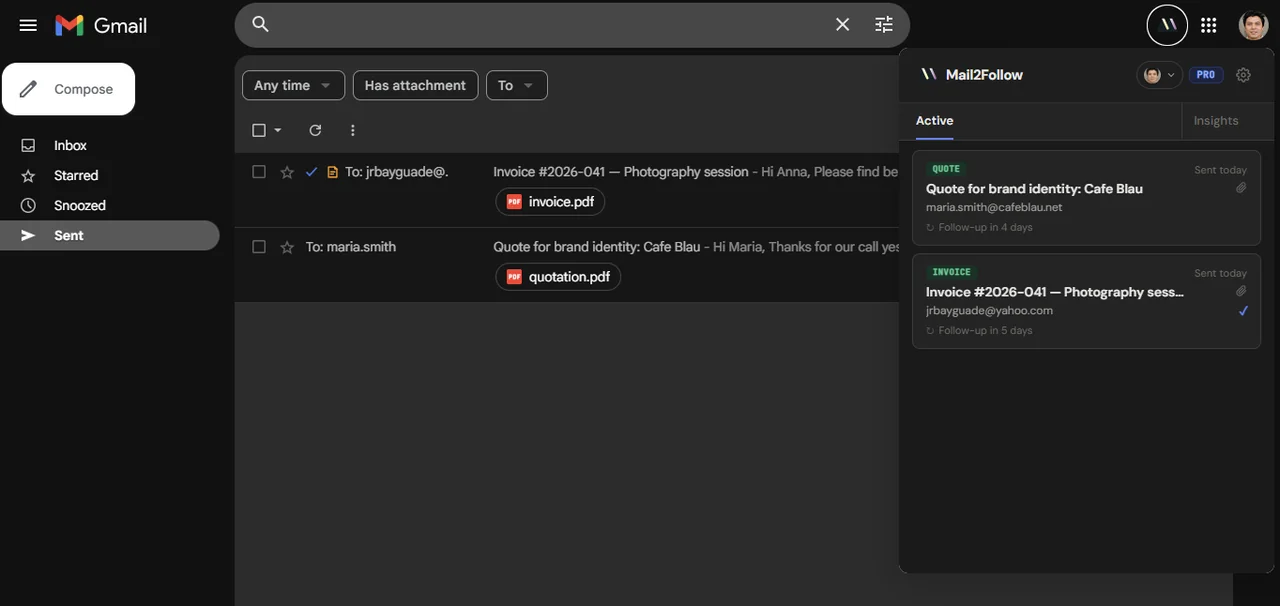
For sensitive recipients (banks, healthcare, legal), Mail2Follow ships an automatic blocklist based on the Mozilla Public Suffix List that disables tracking on those domains. The privacy posture is built in, not an afterthought, which matters when an independent professional wants to claim a privacy-respecting stance with their own clients.
- If opened: address the likely blocker directly, not the silence.
- If unopened: a short, low-edge resend, written as if the first message never arrived.
- Tone calibrated to evidence, not to anxiety.
Using AI Drafts to Match Your Tone, Not a Template
The blank-page problem is the reason most late invoices stay late. A freelance illustrator opens a reply window, stares at the cursor for ten minutes trying to find a register that is firm without being cold, gives up, and closes the tab. Three days later the invoice is still unpaid.
Templates are the usual escape hatch, and they are also the reason most follow-ups sound like a billing system. A generic “this is a friendly reminder that invoice X is now overdue” template does not know that the illustrator and the client have been on first-name terms for two years. The template flattens that history into a single neutral voice.
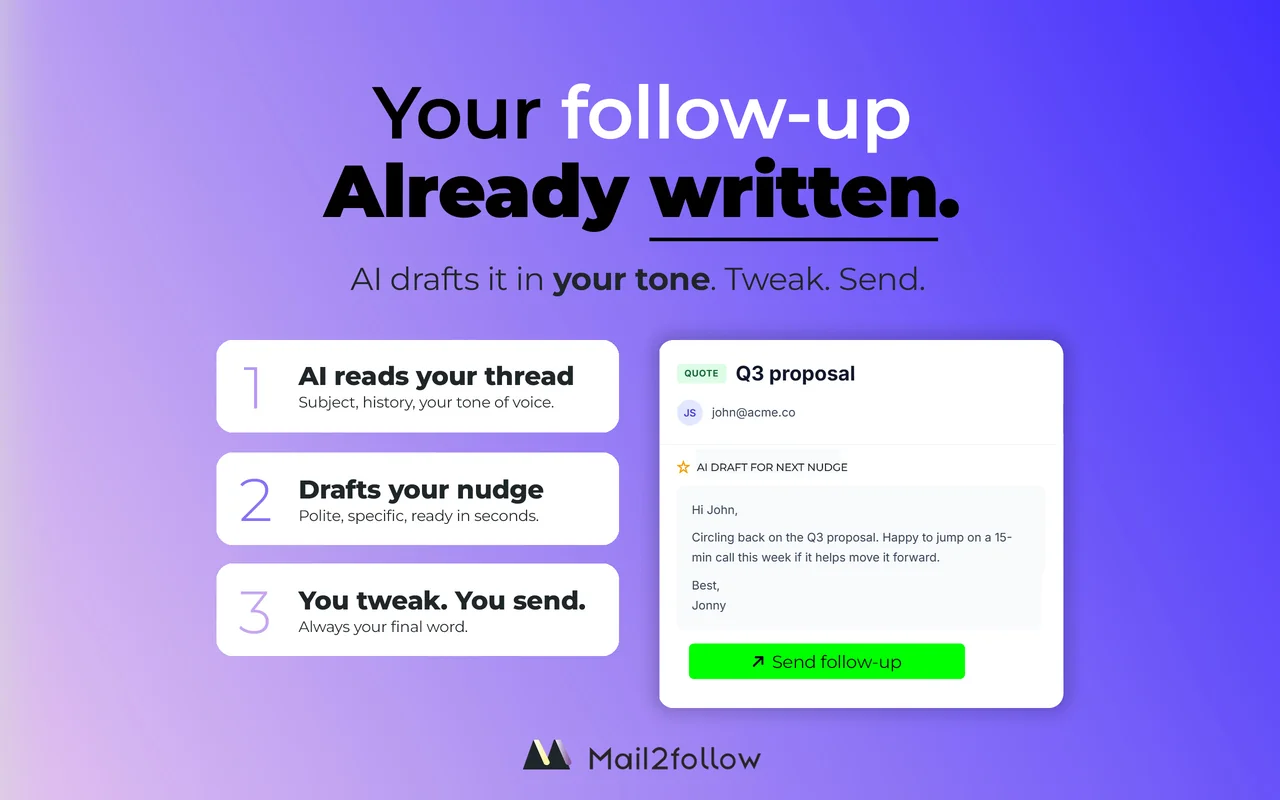
Mail2Follow takes a different approach. The draft panel reads the original thread, picks up the register the two parties have been using, and proposes a follow-up in that voice. The illustrator does not start from a blank page; they start from an edit.
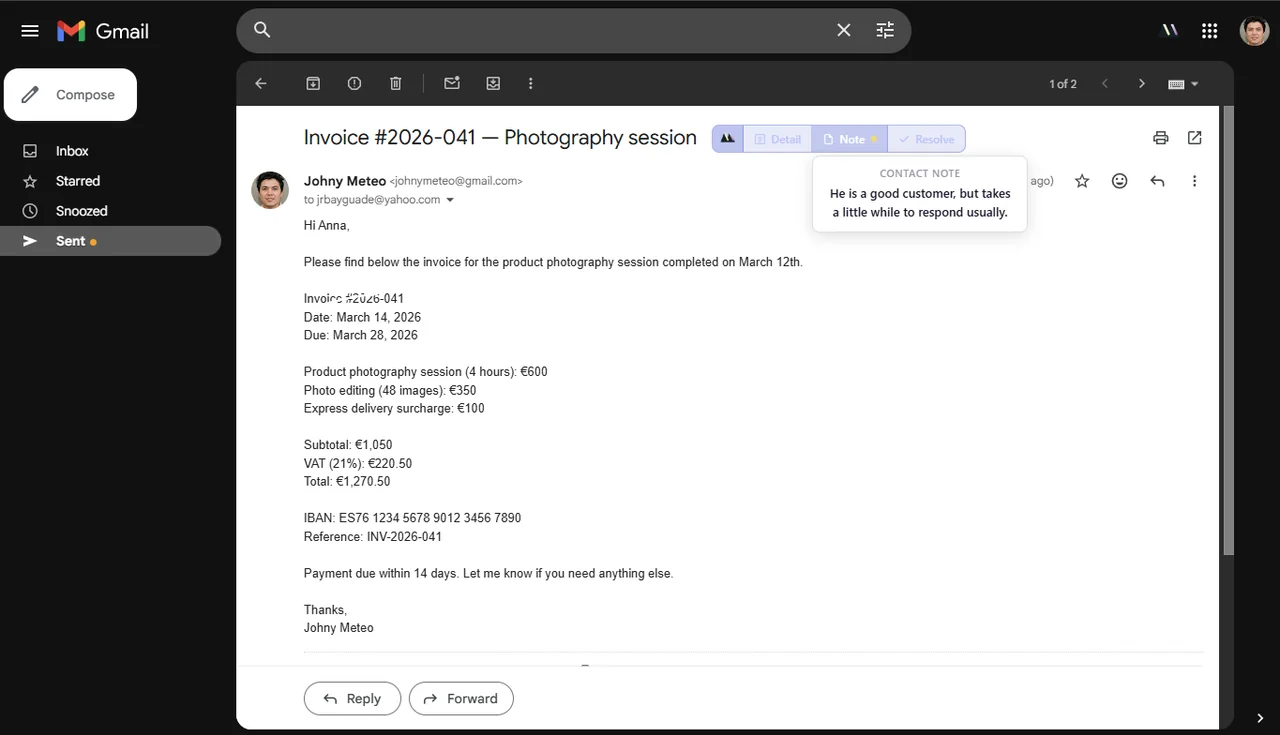
For threads with private context the AI cannot infer (a phone call where the client mentioned payment would come after their quarterly close, for example), inline notes attach that context to the thread itself, and the next draft factors it in.
A drafted version of the day 14 nudge for the translator earlier in this post might come back looking like this:
Hi Anna,
Just circling back on invoice 2026-014, it’s now about two weeks past due and I wanted to check whether something is blocking it on your side, an approval step or anything I can help untangle. Happy to send it straight to whoever handles payments if that’s easier.
The voice is recognisably Marta’s. The ask is clearer than on day 7. Marta did not write that message from scratch; she edited a draft that already understood the thread.
Real Scenarios: Designer, Translator, Small Agency
The same principles play out differently across roles, because the relationships and the stakes are not the same.
Take a freelance graphic designer chasing a 1,400€ invoice from a four-year client, an indie publisher in Madrid. The relationship is warm, the invoice is fifteen days late, and the designer’s biggest fear is being the person who “gets weird about money”. The right move is the day 14 nudge, written in the casual voice of the existing thread, with a direct offer to forward the invoice to the publisher’s bookkeeper. No apology, no formality shift, no apocalyptic framing. The invoice is paid the next day because the founder genuinely forgot, and the relationship is unchanged.
The translator with a monthly retainer is a different shape. The retainer is 2,200€ a month and the client has paid on the same day for eleven months in a row. Month twelve goes silent. The translator’s anxiety is not really about this month’s invoice, it is about whether the retainer is quietly ending. The right follow-up addresses both questions at once: a short nudge on the specific invoice, plus an open-ended line about scope for the following month. The answer reveals which problem actually exists, and the translator stops spending mental energy on the wrong one.
The two-person agency in Barcelona has the most complex picture. They have eight invoices in flight across five clients, and the founder is trying to track all of them in a spreadsheet that is already two days out of date. Their problem is not how to write a single follow-up; it is how to know which one needs writing first. A Gmail-native dashboard that surfaces tracked invoices and their open status removes the spreadsheet entirely and lets the founder spend the morning sending three calibrated nudges instead of an afternoon reconstructing what was sent when.
In all three cases the principle is the same: the follow-up that works is the one that matches the relationship. A 1,400€ invoice from a four-year client and a 12,000€ invoice from a six-month client are not the same conversation, and pretending they are is what makes follow-ups feel awkward.
The Follow-Up That Preserves the Relationship
A follow-up that preserves the relationship is not a softer follow-up. It is a more accurate one. It arrives at the right moment, in the voice the two of you have actually been using, with an ask that is proportional to how late the invoice is and how much you know about why.
The goal is payment, not punishment. Every formality you add, every apology you tack on, every register you switch into, is a small signal about how you see the situation. Clients read those signals. A freelance accountant who keeps the warmth and adds the specificity gets paid and gets next quarter’s work. The one who reaches for a stiff template gets paid this time and quietly drops down the priority list for the next project.
Tone is not a cosmetic layer on top of an unpleasant task. It is the task. Get it right and a late invoice becomes a five-minute exchange between two professionals who respect each other. Get it wrong and a 1,400€ invoice costs you the next 14,000€ of work.
- Match the voice of the existing thread.
- Calibrate the ask to elapsed time and to evidence (opened or not).
- Treat the client as a busy professional, not a defaulter, until they prove otherwise.
Free forever · 15 tracked emails / month · No credit card