The Quote That Went Quiet: Contractor Follow-Up Guide
A reform contractor sends a 12,400€ bathroom quote on a Tuesday morning, before the first job of the day. By Friday, nothing. By the following Wednesday, the thread has slid four screens down the inbox, buried under supplier confirmations, two new lead requests, and a chain about a delayed tile delivery. The client has not said no. The client has not said anything.
That silent week is where most small contractors lose work, and they lose it not to the cheaper bid but to the contractor who remembered to write a second email. The quote did not fail. The follow-up never happened.
Why Quotes Go Cold (And It’s Not Because They Said No)
The reform contractor’s bathroom quote did not get rejected. It got compared to two other bids, then interrupted by the client’s own meeting, then forgotten because the client spent the weekend at her in-laws and came back to forty-three new emails on Monday. By the time she remembered the quote, three days had passed, replying felt awkward, and the easier move was to wait until the contractor wrote again.
That is the silent default. Most clients do not actively reject quotes; they passively park them. The mental model “no answer means no” treats the inbox like a courtroom, where silence is a verdict. It is not. The inbox is a waiting room with no receptionist, and the client is one of fifty people in it.
This matters because the working assumption changes the response. If silence means rejection, the contractor moves on, swallows the lost time on the site visit, and writes the quote off. If silence means the thread got buried, the contractor sends one well-timed email and recovers a job that was never actually lost.
The freelance designer pricing a brand refresh, the electrician scoping a panel upgrade, the architect bidding on a small renovation: all of them face the same dynamic. A quote sits in a thread. The thread gets buried. The client is busy. The contractor assumes the worst. The job goes to whoever wrote the second email.
The Five-Day Window: When Follow-Ups Actually Work
There is a useful rule of thumb among independent service providers: if a quote has not had a reply in five business days, the silence is almost certainly logistical, not commercial. The client has either compared bids and is leaning your way but waiting on something internal, or has lost track of the thread entirely. Either way, a follow-up on day five or six lands in a context where the client is mildly relieved you wrote.
Wait beyond ten days and the calculus shifts. The client now has to explain the silence, which feels awkward, which makes them less likely to reply at all. Wait beyond two weeks and the quote starts to feel stale, the numbers questionable, the urgency gone.
The contractor’s problem is that this five-day window almost never aligns with a moment of inbox attention. Tuesday’s quote needs a follow-up by the next Tuesday or Wednesday. That is exactly when the contractor is on a job site sealing a kitchen, with hands too dusty for a phone and a head full of grout.
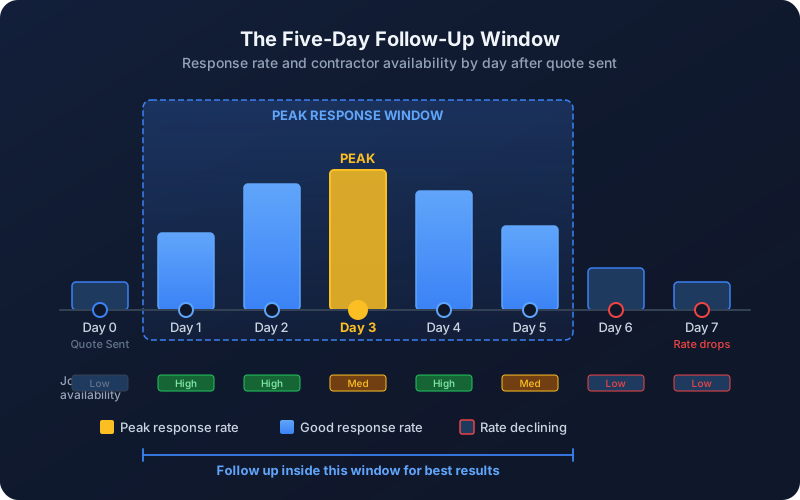
- Day 0: quote sent.
- Day 1 to 3: client reviews, may compare bids, often forgets to reply.
- Day 5 to 6: prime follow-up window. Client expects to hear from you.
- Day 10+: silence calcifies. Reply rates drop. Quote feels stale.
What Your Follow-Up Email Should Actually Say
A follow-up that works is not a nudge and not a guilt trip. It is a useful addition to the thread that gives the client a concrete reason to engage today rather than next week. The plumber following up on a boiler replacement quote does not write “just checking in”. He writes about the part availability that affects the install date, or the supplier price that is locked through the end of the month.
The structure is simple. Reference the original thread so the client does not have to scroll. Add one piece of new information. Make the next step obvious.
Hi Laura,
Following up on the quote I sent last Tuesday for the bathroom reform at Carrer Aragó (12,400€, three-week timeline).
Quick update on timing: the supplier confirmed the porcelain tiles you liked are in stock through mid-June, so if we close this month I can hold the start date for the second week of June. After that the delivery window pushes to mid-July.
Happy to walk through any line of the quote if useful, or to adjust the spec if the budget needs to land differently. What works on your side?
Notice what is not in there. No apology for writing again. No “I know you must be busy”. No “just wanted to make sure you got my email”. The tone assumes the client is a professional who appreciates a useful update, not a debtor who needs to be reminded.
Tracking Quotes Without a Spreadsheet
The reason most contractors do not follow up is not laziness. It is that the tracking system, the part where you remember which quote went out when and which ones are still open, lives nowhere. Or it lives in a notebook on the dashboard of the van, or in a spreadsheet that gets updated for two weeks and then abandoned.
Mail2Follow takes a different angle. The outstanding quotes surface directly in Gmail, in the same screen the contractor already opens twenty times a day. There is no separate dashboard to log into, no app to remember to check, no spreadsheet to maintain. A quote sent on Tuesday morning shows up Friday afternoon as a tracked thread that has not had a reply, with a suggested follow-up date already pencilled in.
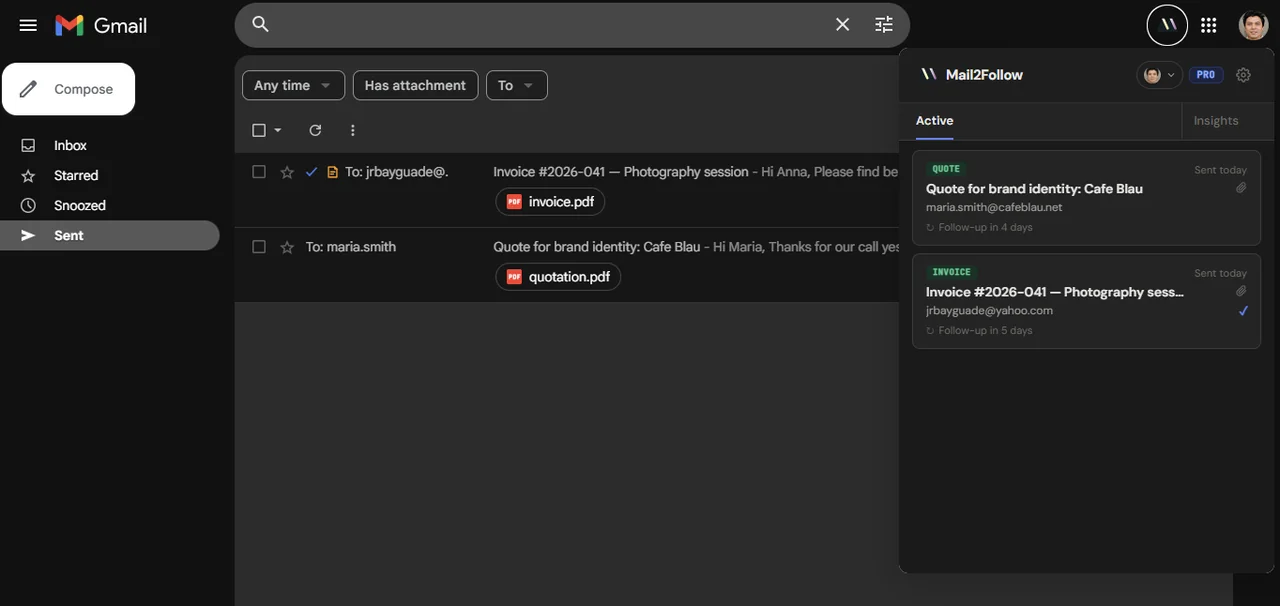
The status chips are the small thing that turns this from a feature into a habit. A quote either has a reply, is awaiting one, or is overdue. The contractor scans the list once over morning coffee and knows in fifteen seconds which three threads need a second email this week. The plumber with five open boiler quotes, the electrician with three panel upgrade bids, the small reform crew juggling eight active proposals: all of them get the same five-second answer to “what needs my attention?”.
- The notebook on the van dashboard.
- The spreadsheet that gets abandoned by week three.
- The mental note that “I should follow up on the Aragó job”.
- The Sunday-night session of scrolling through sent mail to find open quotes.
The One Thing That Makes a Follow-Up Feel Professional
Frequency is not what makes a follow-up feel pushy. Tone and context do. Two follow-ups on a single quote, spaced a week apart, with new information in each, feel attentive. One follow-up that reads “just bumping this to the top of your inbox” feels desperate, regardless of how rarely it is sent.
The professional follow-up does three things at once. It references the original thread by detail (not just “my email last week” but “the bathroom reform quote at Carrer Aragó”). It adds one new piece of value, supplier timing, a clarifying note, an option the client did not ask about but might want. And it makes the next step a small ask, not a closed yes-or-no.
Adds nothing to the thread. Tells the client you have run out of things to say. The client now has to do the work of restarting the conversation.
Filler that signals the contractor is uncomfortable writing. Strip it. Open with the substantive update.
Forces the client to either lie politely or admit they ignored it. Both outcomes hurt the relationship.
Apologising for writing teaches the client that your follow-ups are an imposition. Drop the apology.
Counting your own follow-ups out loud reads as accusatory. Each follow-up should stand on its own merits.
The architect who writes one substantive follow-up per quote, every time, looks more professional than the one who writes six apologetic ones. The freelance translator who says “the rate I quoted holds through the end of the month, after that I will need to revisit it” gives the client a reason to reply this week, without pressure.
How AI Drafts Save You Time on the Job Site
The contractor sitting in a van between jobs does not have ten minutes to compose a follow-up email from scratch. Even when the intent is clear, the blank-page friction is enough to push the task to “tonight”, and tonight rarely happens.
Mail2Follow drafts the follow-up by reading the original thread and matching its tone. If the original quote was formal and detailed, the draft is formal and detailed. If the thread has a casual back-and-forth with the client (a regular customer, a referral, a neighbour), the draft reflects that register. The contractor reads it, edits a sentence if needed, and sends.
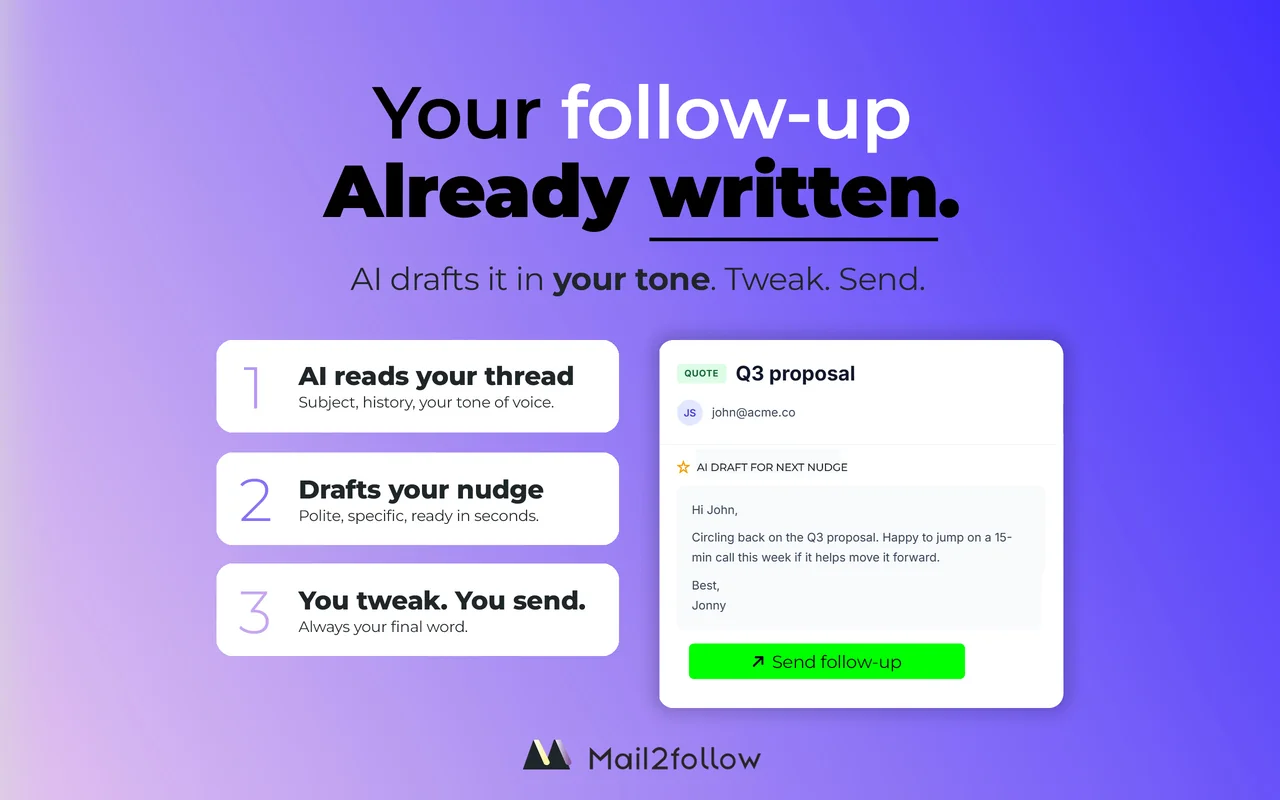
The shift is from writing to approving. Approving a draft takes thirty seconds between jobs. Writing one from scratch takes ten minutes and an empty van.
- Drafts are tone-matched to the original thread, not generic templates.
- Editing a draft fits in the gap between two job-site stops.
- The blank-page tax disappears, which is the real reason follow-ups get skipped.
From Silence to Closed: Real Patterns from Contractors Who Follow Up
Spend any time on contractor forums and one pattern recurs: the trades who track and follow up on every quote, even briefly, close materially more work than the ones who send and hope. They are not better salespeople. They are not cheaper. They are just the second email.
The reform contractor who sends fifteen quotes a month and follows up on all of them is competing against contractors who send fifteen quotes a month and follow up on none. The first contractor wins jobs that were never actually lost, just buried. The second contractor watches half a quarter of work walk away in silence.
This is not a sales technique. It is a calendar discipline. The freelance photographer chasing wedding bookings, the small electrical crew bidding on commercial fit-outs, the plumber sending boiler replacement quotes through a cold January: the same pattern. The work goes to whoever remembered to follow up at day six instead of giving up at day ten.
The silence is not the verdict. The silence is the test of whether you have a system that surfaces buried threads while you are on the job site, or whether you are relying on memory and a notebook that lives in the van.
Free forever · 15 tracked emails / month · No credit card