Invoice Overdue: A Freelancer's Step-by-Step Escalation Guide
You sent the invoice three weeks ago. The payment terms said net 14. It is now day 21, and nothing has landed in the account. The client is someone you like, someone you want to keep, and someone whose next project is probably worth more than the unpaid bill currently sitting in your sent folder.
So you do what most solo professionals do: you wait another day. Then another. Then you draft a message, delete it, draft it again, and end up sending nothing because every version sounds either too soft to matter or too sharp to forgive.
The standard advice (“just send a polite reminder”) skips the actual problem. A freelance illustrator with six active clients cannot treat one of them as a debt-collection target. The relationship is the asset. But silence is not professionalism either; silence is a quiet message that your invoices are optional. The fix is a structured escalation that reads as continuation of a professional conversation, not as the opening shot of a dispute.
- Why invoices go unpaid, and why it is rarely personal
- A three-stage escalation framework you can run from Gmail
- Why staying in the original thread changes the tone
- How to run the day-7 reminder with Mail2Follow
- Matching your tone to the relationship
- Common mistakes that damage the client relationship
- When to escalate beyond email
Why invoices go unpaid (and why it matters to your relationship)
A late invoice almost never means the client has decided to stiff you. The European Payment Report from Intrum has tracked late B2B payment as a structural feature of European commerce for years, and the pattern is consistent: most late payments trace back to administrative friction, not bad faith. The invoice landed in a shared inbox during a busy week. The approver was on holiday. The accounts team batches payments to Fridays and your invoice missed the cutoff. The PO number on your line item does not match the PO number in their system, so it is sitting in a manual-review queue no one is looking at.
If you start the reminder from the assumption that the client is dodging you, every word that follows carries that suspicion. The client hears it. The freelance translator who opens her day-21 reminder with “I notice you have not paid” has already lost some of the room she needs to land the actual ask.
The reframe is mechanical, not emotional. Treat the overdue invoice as an administrative event that needs a status update, the same way you would treat a missing courier delivery or an unreturned form. Your job is to surface the issue clearly, give the client a frictionless way to resolve it, and protect the working relationship that produced the invoice in the first place.
That reframe is what justifies a structured response. Escalation is not aggression. It is the professional alternative to either silence (which trains the client to deprioritise you) or to a single emotionally charged message (which damages a relationship over what may be a clerical error).
The three-stage escalation framework
The framework below assumes a 14-day payment term, the most common net-period for freelancers and independent professionals in Spain and across the EU. Adjust the calendar offsets if your terms differ; the shape of the escalation stays the same.
Each stage has a different job. The day-1 reminder assumes oversight. The day-7 reminder establishes that the terms are real. The day-14 notice puts a concrete next step on the table without threatening. Notice that none of these stages requires you to be angry, accusatory, or apologetic.
One day after the due date, reply inside the original invoice thread with a short, friendly nudge. Reference the invoice number and due date factually. Assume oversight. Offer to resend the PDF in case it got lost. Tone: helpful colleague, not creditor.
One week past due, reply again in the same thread. This time, name the payment term explicitly (“our agreed net 14 terms”) and ask for a specific status update or an expected payment date. Tone: professional, slightly more formal, no apology for asking.
Two weeks past due, the message names the consequence of continued non-payment without making it a threat. State the date you will pause ongoing work, apply a late fee per the contract, or move to a formal collections process. Offer a 48-hour window to resolve.
The reason this cadence works is that it gives the client three escalating opportunities to behave like a professional before you have to behave like a creditor. By day 14, if the silence continues, you have a clean paper trail of three measured, in-thread messages. That paper trail matters if the dispute ever moves to a Spanish small-claims process (the juicio monitorio, which accepts simple email evidence of an uncontested debt) or to the equivalent UK or French simplified-recovery procedures.
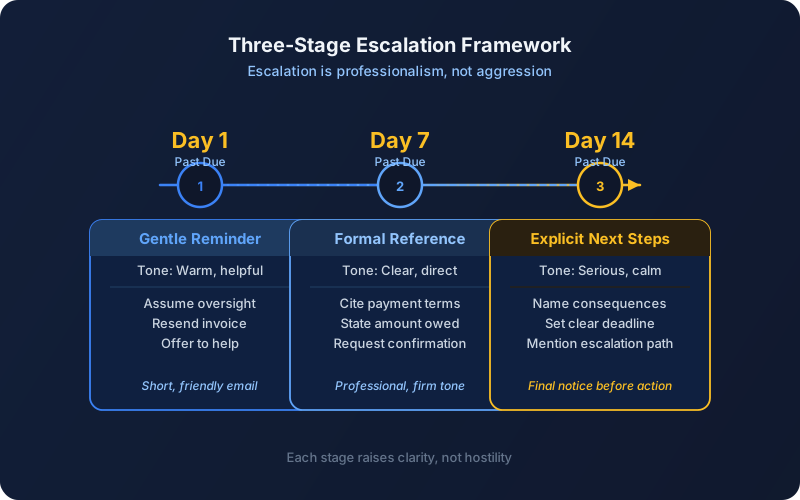
- Day 1: assume oversight, offer to resend the invoice.
- Day 7: name the payment terms, ask for a status date.
- Day 14: state the concrete next step, give a 48-hour window.
Why thread continuity matters more than you think
There is a tactical decision hidden inside every overdue-invoice reminder: do you reply inside the original invoice email, or do you start a new message with a new subject line? Most freelancers default to the new message, because it feels cleaner. It is the wrong call.
Replying inside the original thread does two things at once. First, it preserves the full context: the original invoice PDF, the agreed scope, the date you sent it, the client’s own acknowledgement that they received it. The accounts payable clerk who eventually opens your reminder can scroll up and find every piece of information they need to release the payment, without asking you for anything.
Second, and more importantly, an in-thread reply reads as continuation. A new email with a subject like “Outstanding invoice 2024-118: payment overdue” reads as escalation, because the change of envelope signals a change of stance. The recipient feels the shift before they read a single word. The same content delivered as a reply to the original thread carries none of that charge; it reads as the next message in an ongoing professional exchange, which is what it actually is.
For the independent consultant who sends a proposal to a hospital procurement office and then invoices against it, this difference is the entire game. The procurement office is processing dozens of invoices a week; your in-thread reply lands as a clarifying nudge on a known item, not as a complaint that has to be routed to a manager.
- The accounts payable team can verify the invoice without asking you for context.
- The reply reads as continuation, not as a confrontational restart.
- You build a clean, chronological paper trail in one place.
How Mail2Follow keeps your follow-up in the right conversation
Knowing you should reply in-thread on day 7 is one thing. Actually remembering to do it, finding the original thread among three months of email, and writing the message in a calm moment rather than a frustrated one is another. This is where Mail2Follow does its quiet work.
The workflow is short. When you send the original invoice from Gmail, you enable Mail2Follow tracking on that send with a single toggle in the compose window. The toggle is visible above the body field; one click and the thread is now under Mail2Follow’s eye.
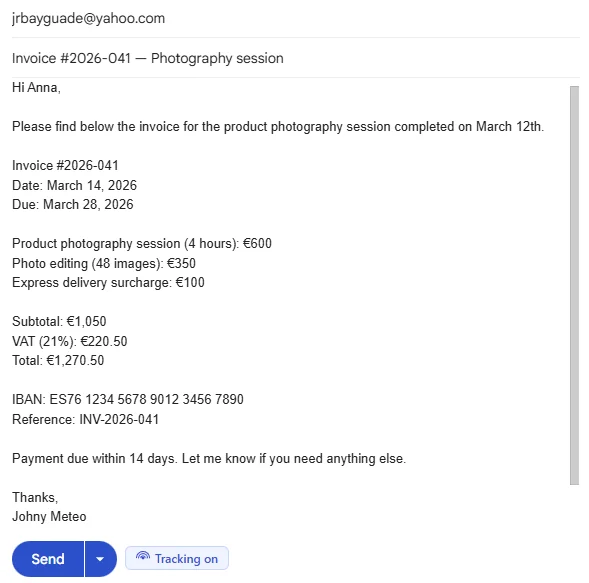
From there, the rest happens inside Gmail. On day 7 past the due date, Mail2Follow surfaces a reminder directly inside the original invoice thread. You do not get a notification in a separate dashboard you forgot existed. You open Gmail, the thread floats to the top with a reminder badge, and the AI draft panel offers a follow-up message that already matches the tone of your original invoice email. You read it, edit two lines, and hit send. The reply lands inside the same thread, attached to the same invoice PDF, in the same conversation you started three weeks ago.
A representative day-7 reply for a freelance designer chasing a midsize agency might look like this:
Hi Marc,
Just following up on invoice 2024-118 (sent 12 May, net 14 terms), which is now a week past due. I want to make sure it has not gotten stuck somewhere on the way to accounts payable.
Could you let me know the expected payment date, or who I should contact directly if the invoice needs to be re-routed? Happy to resend the PDF if it would help.
Thanks,
Three things to notice. The subject line is the original invoice subject prefixed with “Re:”, because Gmail handles the threading. The tone is factual, not aggrieved. And the message ends with a low-friction offer to help (resending the PDF, naming a contact), which gives the client an easy positive action to take instead of an apology to write. Mail2Follow’s AI draft scaffolds this shape for you; your job is to tweak, not to start from a blank page at 11pm.
If you are on Mail2Follow’s free tier, the reply detection and the in-thread reminder still work; the pixel-based open detection is the Pro feature, and it is not what makes this workflow function. Reminders fire on calendar time, which is what the escalation framework needs.
Matching tone to the relationship (and why the AI helps)
Every freelance practice has at least two client registers. The boutique architecture studio you have worked with for three years gets one tone; the new corporate client whose legal team negotiated the master services agreement gets another. The day-7 reminder you send to each of them cannot use the same words.
This is where the blank-page problem bites. Writing a firm-but-warm reminder to a long-term client at the end of a long week is genuinely hard. Most people overcorrect. They either write three apologetic paragraphs that bury the ask, or they paste a debt-collection template they found on a forum and send it to someone who would have paid the next day if asked nicely.
Mail2Follow’s AI-drafted follow-up reads the original thread before drafting. If you wrote the original invoice email in a relaxed register (first names, no formal sign-off), the draft comes back in the same register. If the original was a formal cover note attached to a contract with a procurement office, the draft comes back with full names and a “Best regards” sign-off. You are not editing tone; you are editing facts.
That last point is the practical one. For the freelance translator running fifteen active client relationships, the difference between sending the day-7 reminder and skipping it is rarely a question of principle. It is a question of friction. A guided edit takes ninety seconds. A blank page at the end of a tired Thursday takes twenty minutes that you do not have, so the reminder never goes out, and the invoice stays unpaid for another two weeks.
Common mistakes that damage the relationship
The escalation framework above works because it avoids the patterns that actually hurt client relationships. The mistakes below are the ones that recur when freelancers handle overdue invoices reactively rather than systematically.
"Just checking in on that invoice" forces the client to search their own records to figure out which invoice you mean. Always reference the invoice number, the original date, and the amount. Reduce the work the client has to do to act on your message.
Phrases like "I am very disappointed" or "this is putting me in a difficult position" shift the conversation from administrative to emotional. The client now has to manage your feelings before they can release the payment. Stay factual.
Mentioning "legal action" on day 8 when you have no intention of filing anything trains the client to ignore your warnings. If you name a consequence (pausing work, applying a late fee, filing a monitorio), be ready to act on it on the date you stated.
Emailing, then WhatsApping, then LinkedIn-messaging the same person about the same invoice in the same week reads as panic. Pick one channel (email) and run the escalation through it. Only switch channels when the email cadence has clearly failed.
A new subject line resets the context and signals confrontation. The accounts payable team loses the link to the original invoice and has to reconstruct it. Reply inside the thread that contains the invoice PDF.
"Sorry to bother you about this" undermines the legitimacy of the request before it is made. You are not bothering them; you are doing the administrative work of running a business. A neutral opening (a direct reference to the invoice and the date) is professional, not rude.
When to escalate beyond email
Email is the right medium for the first three stages of an escalation, but it is not infinite. If day 14 passes without a response, the assumption that the silence is administrative starts to weaken. At that point, the escalation needs to move off the email layer.
The right next step is a phone call to a named human, not a fourth email. The phone call surfaces information email cannot: the AP clerk is on parental leave, the company is restructuring, the contact you have been emailing left two weeks ago. None of that comes through in silence on a thread.
After the phone call, the options depend on the amount and the jurisdiction. In Spain, the juicio monitorio is designed exactly for uncontested debts and accepts email correspondence as documentary evidence; the threshold and the procedure are documented by the Consejo General del Poder Judicial. In other EU member states, the European Order for Payment procedure (Regulation EC 1896/2006) provides a cross-border equivalent for invoices against clients in other EU countries. A small-claims solicitor or a gestor can run the paperwork for a fraction of what most freelancers assume it costs.
Should I add late fees to the day-14 message?
Only if your original contract or invoice already specified them. Inventing a late fee in the reminder reads as retaliatory and is unenforceable. If your contract was silent, the day-14 message can reference the legal interest rate for late commercial payment (in Spain, set quarterly under Ley 3/2004) without specifying a euro figure.
What if the client says they cannot pay right now?
Take it as good news; you now have information. Offer a written payment plan (two or three instalments with explicit dates), confirmed by email reply so it is in the thread. A documented plan is far better than an open-ended "pay when you can" that you will be chasing again in six weeks.
At what point is it not worth the effort to keep chasing?
That is a personal calculation, but a useful rule of thumb: if the unpaid amount is less than what a monitorio filing or a collections agency would cost you in fees and time, accept the loss and stop working with the client. The escalation framework should already have given you the paper trail you need to make that decision cleanly.
Should I keep working on other projects for the client while an invoice is overdue?
Until day 14, yes; assume oversight and protect the relationship. From day 14 onward, the day-14 message should name the pause clearly: ongoing work stops on a specific date if the overdue invoice is not settled. Continuing to deliver while invoices stack up trains the client that your payment terms have no teeth.
- Three in-thread replies on days 1, 7, and 14, each with a different job.
- Tone matched to the relationship, not to your mood that morning.
- Off-email escalation reserved for after day 14, and only after a phone call.
- A clean paper trail that supports a monitorio or equivalent if it ever comes to that.
Free forever · 15 tracked emails / month · No credit card